Search This Blog

Tuesday, October 20, 2015

My Miscarriage

Today I finished miscarrying my second pregnancy.

My first pregnancy went about as swimmingly as any could (save for the severe nausea I had until week 19). But with the second, all of my worst fears were realized.

I say "pregnancy" and not "baby" or "child," because those words would not be accurate. This was what is sometimes known as an anembryonic pregnancy. Which means there was no embryo to be found. So, you see, it would not be accurate or precise to say anything other than "second pregnancy."

But even without an embryo, I was still considered pregnant. When I took a test it always came back positive because my hormone levels were still elevated.

But when 8 weeks came, and we got into the ultrasound room, the terrifying picture I saw looked like this:


My heart immediately sank. You see, I knew from my first pregnancy that this is actually what the ultrasound should look like:


That's my Joshua at 8 weeks gestation.

Something wasn't right. We speculated that maybe that I was not as far along as I thought. But I knew. There was pain and bleeding, and I knew. 

I had hoped and prayed that God would perform a miracle. Please, spare me this, I begged. I cannot bear it

But even as my mother drove me to my follow-up with the OB, I knew.

It wasn't that I thought God could not do it. It was that I knew that the answer was no. For whatever reason, I knew that this was not the time.

Let me tell you, there is so much I did not know about miscarriage. I would learn in the coming days that most women opt for a D&C, a surgery that involves removal of the tissues inside the uterus. Worried about damage a D&C might cause to my uterus and effects it might have on future pregnancies, I opted for Misoprostol, a drug used to induce contractions and speed up the miscarriage process. Misoprostol posed no threat to future pregnancies, and would help me avoid potentially months of bleeding. It was a Wednesday when I took it. I went straight from school to my OB. That night, I stayed home and waited for something to happen. And waited. And waited. Thursday morning, I woke up worried it didn't take (that happens sometimes). But then, the worst pain I've ever endured.

I had never endured so much pain. I now understood the Hydrocodone prescription my doctor had given me. I felt so mixed-up. For all the things I was going through physically, and only being able to take one day off from school, there was barely time to process my emotions. And today, as the physical part of this miscarriage ends, the emotional damage is hitting me and sinking in fully.

I lost it. I lost a pregnancy. When all of my other pregnant friends deliver their spring babies, I will be baby-less. What do I do? How can I see all of those babies with the same due-month and not think, why me? 

Mourning. The worst feeling I've ever felt.

But I don't know how to mourn the loss of something that was never mine. An anembryonic pregnancy. Do I find peace in the fact that there is no loss of an embryo here? Do I find peace in not having carried a baby longer, or even bringing them into the world, only to lose them later? I don't know.

I have a uterus that played the nastiest trick on me. It made me believe there was life inside. It lied to me. 

This is a pain I cannot bear. I do not know how to be this person. I do not know how to come out of this daydream--or daynightmare. I don't know how to wake up from the hazy tailspin this experience has put me through.

--

As I come back to this post three weeks later, I realize the daze I am still in. But I have also realized that I cannot live in this delirium. 

I have been told several times by well-meaning people that it's okay to be mad at God. 

But I am not.

To be mad at God would be nonsensical of me. God is not the cause of the suffering we endure. Sin is. From the moment sin entered the world (a choice made by man), evil came with it (Genesis 3:14-19). Suffering. God brings peace, and comfort, and joy. God is the author of good (James 1:13-17). To be angry at God would be a great display of immaturity on my part. Like a toddler throwing a tantrum at his mother when he throws his own toy and breaks it.

I can't explain all of the little things that have happened to me in the last few years. But all of those little things have brought my relationship with God to a very specific understanding: God is the cause of peace and comfort. To be at peace and feel comforted is not a natural state. It is something brought on by God. My natural state as a human being, honestly, is anxious. Worried. Doubtful. Insecure. But God steps in and changes that. He brings me peace and healing. He makes me whole.

So, why, then, would I assume that God suddenly changed his tune and decided to bring me only terror, fear, and suffering? It would not make any sense.

So now is the time for me to persevere and lean further into the embrace of the One who wants nothing but the utmost comfort for me. His answer will not always be yes. But his objective will always be peace.


Friday, August 8, 2014

On The Power of Perception


We love opinions.

We live in a society where everyone has a platform on which to share their opinions; social media is rampant with them. We ask for the opinions of our friends when considering options for ourselves on everything from a coffee maker to our primary care physician. If a trusted friend tells me that they had a horrible experience with a certain model of Keurig machine, you can bet I'm not going to waste my money on it!

Those opinions are built entirely on experiences and shaped by perceptions. Consider the following example:

Experience: At a new restaurant in town, my waiter forgets to refill my drink, gets my order wrong, and takes too long to get back to my table with our check.
Perception: This is a bad waiter.
Opinion: That restaurant has terrible service.

I worked in the restaurant business for several years, and something that my bosses told me over and over again was this: "perception is reality." Basically, however the customer perceived you was their reality, and there was little you could do to explain or argue your way out of it. You simply had to prove them wrong with your service.

I have adopted this phrase in my life as well. Especially when it comes to conflict resolution, I think it's important to remember that perception is reality. Whenever someone comes to you with hurt feelings over something, you have to know that the way they are saying that they perceived your actions or words is reality to them.

But something that is equally important that perhaps I have not done a great job of explaining in the past is that perception is simultaneously not reality. The operative part of the phrase "perception is reality" is "to the one perceiving." Just because my perceptions are my reality, it doesn't make them correct. And I think that knowing this as the perceiver is just as important as my offender knowing that my perception is my reality.

In Language Arts classes, we learn in Elementary School how to distinguish facts from opinions. Exercises include looking at statements like these--

"Coca-Cola is the most popular brand of soda in the United States"
"Coca-Cola is the best soda"

--and asking students, "which of these is a fact, and which is an opinion?" I explain to my students all the time the necessity of examining our own opinions for validity, and making sure to constantly support our opinions with indisputable evidence. If we do not support our opinions with evidence, they are considered weak and faulty.

But what if we are building our opinions on faulty perceptions?

What if I told you that the waiter in my first example was covering more than just his section of the restaurant because another waiter didn't show up for his shift, and the manager, instead of helping this waiter, was sitting back in his office checking his Facebook? Would that change your perception of the waiter? And your opinion of the restaurant?

But we would never know that. How can we know if our perceptions are faulty?

Great question! Thanks for asking.

Whenever we have perceived an offense of any kind, what should we do first? Matthew 18:15 tells us to "go and tell [our] brother his fault," meaning we need to approach the person who has offended us, and let them know.

VERY IMPORTANT: This absolutely does not give us license to chew this person out, call them names, make them feel bad, etc. The purpose of "telling your brother his fault" is to fact-find. And that is extremely important to remember. The purpose is not to vent and tell off someone else. If that's your reason for wanting to express your hurt feelings, you need to examine yourself and question whether your motives are godly or selfish.

Remember that this is conflict resolution, not conflict heightening. 

"Telling your brother his fault" is a fact-finding mission because we know that while perception is reality, it is simultaneously not reality. The objective of this conversation with your offender is to find the truth of the matter, not to accuse.

In my Bible class last year, I had to mediate a conversation between some of the girls because so many of them had been offended by so many others of them. I told them, before anyone started talking, to speak cautiously. They were not allowed to make statements that made unfounded assumptions about anyone else. They were only allowed to say how they felt.

I said this coming from a place of experience. Not too long before this incident, a friend who was dear to me had approached me with an offense of her own. However, when she was telling me how some of my actions had made her feel, she simultaneously made assumptions about me. She assumed that I did not care about her or value her enough, and therefore formed the opinion that I was a bad friend. This was ultimately extremely hurtful to me. The reason it was so hurtful was because her perceptions of the experiences she was referencing were so wrong and so skewed, but because of the way she told me my fault, through "I feel [_____________] because you don't care" statements, I was never given the opportunity to correct those misperceptions. When she approached me, it was not a fact-finding mission. She had already formed her opinion, and there was little to nothing I could do to fix it or mend the relationship. This completely broke my heart: knowing that this person had been hurt so badly by my actions, knowing that there was so much I could have said to mend those hurt feelings and correct wrong perceptions,  but knowing that at this point there was not a whole lot I could say to do so, since the opinion was already formed.

So, while her perceptions were her reality, they were simultaneously not reality. This is why conflict resolution is a fact-finding mission. Whenever I approach someone with an offense, especially since that experience, I usually state my feelings, and then make some sort of clarifying statement. I will ask why someone did something that I perceived as hurtful, or ask them to help me understand the situation better. Because I believe that that person is better than the way I am perceiving them. And I want to be sure to give them ample opportunity to shed some light on the experience I am perceiving so negatively before I form the opinion that this person is not a friend, or out to get me, etc.

The offender also has responsibilities of their own. While it is always great to have the chance to correct a misperception, we have to also figure out how that misperception came to be in the first place. Sometimes it is because the offended was having a bad day, or otherwise incapable of viewing things correctly. But sometimes the offender really was careless in their actions or words. Either way, the way we come to resolving conflict is to decide which of these is the case, and how it can be avoided in the future.

Basically, the offender needs to know that perception is reality, but the offended need to know that perception is simultaneously not reality.

So, don't always give so much credence to your perceptions. Understand the difference between opinions and facts. Go on fact-finding missions. Seek the truth. Believe the best in others. Don't give perceptions--those sly little devils--so much power.

Friday, June 27, 2014

On Prioritization


Wednesday was a rough day for me.

There's a very simple explanation for it: baby preparations are stressful! Simply put, all of the wrong circumstances aligned and combined to twist me into a ball of emotions on this particular day. 

So, when my husband got home from work, and then, almost immediately, had to turn around and leave to make it to the church band rehearsal on time, I totally lost it

But my husband did something wonderful. He put down his guitar and his pedal board, knowing he had to leave that moment if he had a prayer of making it to rehearsal on time, and he sat on the couch with me and let me cry on his shoulders. He did so until I made him leave because I knew how late he was making himself. He let me have a chance to calm down, get it together, and let him leave the house.

Relationships depend a lot on proper prioritization. Timeliness on our church worship team is vital. It's a very big deal. It meant the world to me that my husband was willing to make himself late to something he values so much just to let me hug him an extra fifteen minutes. 

I've watched a lot of relationships (not just dating, but friendships as well) deteriorate because of poor prioritization. We let other things take precedence over the people who should really be the most important. Sometimes this happens because we take for granted that those people know we love them, so we don't think they need the reassurance. And sometimes it's genuinely because we've lost sight of the people that are actually important because everything else has so rudely intruded on so much of our time.

What I'm encouraging you to do is very simple. Don't forget who matters to you. Prioritize them on purpose. There is a lot of pressure to give, give, give to everyone--to your friends, to your band, to your job, to your ministry--but don't forget about the people who mean most. When it comes to spouses and future spouses, it's up to you to put them in their place: the top! My boss once told me, "your husband is your first ministry," and that has really resonated with me. My ministries are closest to my heart, but my husband is also my ministry. And I'm the only one who can keep him in his place. And he does the same for me!

And, I'm telling you, until you understand this, until making that person your first ministry really resonates with you, you will struggle to find what you're looking for in a romantic relationship. In the same way that, in our relationships with God--which are supposed to be examples of our relationships with our spouses--we have to deny ourselves over and over again, we have to deny ourselves sometimes in our romantic relationships. We have to put our own agendas and plans aside, shut out the noise, and remember who's most important to us. We have to do this for each other constantly, and we have to trust each other to do this. Otherwise, we both end up only looking out for Number One, and we will both be constantly unsatisfied. 

But because I can trust that my husband has me in my proper place in his heart, and he can trust that I have him in his proper place in my heart, we can both rest in the peace and love that comes with that trust. We can both be completely cared for without having the pressure of needing to look out for ourselves. And that's the ideal spot for me!


Tuesday, May 27, 2014

On Garage Sales and Faithfulness


If you follow me on Facebook, you're more than aware of the Garage Sale that I'm having this weekend.

Sorry for blowing up your news feeds, but we've got a lot of stuff to get rid of and we've got money to raise!

Most of you also know about my job. For those of you who don't, let me introduce you:


These are my students. They are superstars.

I work at a small Christian school in Jacksonville that's doing some pretty awesome things. In particular, we're raising world-changers. No big deal.

All joking aside, I teach English at this small school. We are not just teachers, we are disciple-makers whose biggest hope is to coach and guide these students to be successful, excellent, intelligent Christians. Each and every one of these teachers are excellent in their fields, passionate about the material, and most importantly, they are on fire for answering the Great Commission: to make disciples.

I love my job. There has never been a time in my life when I felt like my job had more meaning.

I also love my husband. If it weren't for him, I would not have been able to accept a position at this school. The reason for that is because this job is a ministry. This particular ministry required me (and my husband) to make certain financial sacrifices.

So, I accepted a pay cut in order to do something much more fulfilling with my time and life, and I have not regretted this decision. This past school year, as it was my first, has been trying and difficult. It has not come without frustration and insecurity, and has stretched me and made me grow. But it has been the most fulfilling year also.

In my last blog post, I talked about trusting God. My life has been a series of events and seasons that have required me to trust God over and over again, and he has always proven faithful.

This past season required me to trust him with finances more than I ever have before. It has really been strange to not bring a lot of dough to the table on my own--as someone who has worked steadily since sixteen-years-old, feeling dependent was not something I was ready for.

My husband and I were at once reminded of God's faithfulness when I very first took this job. My husband confidently said "yes" even though we weren't sure how we would manage. Not long after that, he was blessed with a raise and promotion at his job. This promotion almost made up for the amount I was going to lose from my income by taking my new job. I knew then that God had some pretty amazing things in store.

As you know, we found out in January that we would be welcoming our first little one into the world. We are BEYOND thrilled to be entering into this season, but it did not come without an onslaught of insecurity and doubt. I had a lot of reasons to question my future and wonder in anxiety.

Because of maternity leave and this big change that's coming, I will be teaching less classes next year, which means another pay cut. I was at once nervous, but then relieved. Nervous for what was going to happen to us financially, but relieved to have a less strenuous schedule with Baby coming.

I have been trying to no avail to find a part-time job for the Summer. It has become evident that maybe I need to take some time to rest in God's faithfulness.

In the week since the last day of school, with two paychecks left from last school year still on their way, we've already seen evidence of God's faithfulness once again. Some family of mine have been extremely generous in helping us prepare for Baby's arrival. It was unexpected and unsolicited. What an amazing surprise!

I am so confident in the faithfulness of God, that I look toward a Summer without my regular pay check and I know that my husband and I will not be in want for anything. I am not worried, I am not anxious; I am excited to see the ways that God plans to show off in our lives.

Now, in the spirit of preparation, I have planned my very first Garage Sale for this Saturday! There were multiple motives for this (as is typically the case with garage sales): I do not want to be a packrat, and am eager to get rid of things we do not use anymore. But I also want to raise some money to prep for Baby's arrival!

I am coming into this Garage Sale with a sense of expectation. The choosing and pricing of each item I am selling has been prayerfully considered, and I am really expecting this to be another opportunity for God to show himself off.

BONUS: My friends, the Brownings, are joining us for this Garage Sale to raise money to fund their Ethiopian adoption! I also have high expectations for them--I know this will be another opportunity for God to show off for them!

Thursday, May 8, 2014

On Inferior and Unstable Callings


This morning, I was bombarded with e-mails and notifications that threw me pretty quickly into a feeling of melancholy. Why? Well, firstly because I'm pregnant and my hormones ensure that I am quite on the edge at all times. But also because these e-mails and notifications were intimately intertwined with questions that I have been asking God to reveal the answers to for quite some months. These e-mails and notifications weren't answers. They were just more mud in what has been an already muddy situation. The sort of situation where choices you have to make are not cut-and-dry. The correct choice is not obvious; it's hidden.

So I sat on my couch for a few minutes and stewed. I then decided that I needed to take some time and do my favorite thing: worship.

So, I put my phone on "Do Not Disturb" mode, turned on my iPhone speaker and pumped out some of my favorites. My voice was not warmed up, it was just my just-woke-up-groggy voice. But I belted it. There was something inside that I just needed to get out. I'm sure you know the feeling.

In this moment, I got to hear the bridge to one of my favorites in a new way:

Spirit, lead me where my trust is without borders
Let me walk upon the waters
Wherever You would call me

Take me deeper than my feet could ever wander
And my faith will be made stronger
In the presence of my Savior

What Am I Doing?

If you're like me, you have not always known what it is that you are called to do with your life. If you're exactly like me, you seem to be surrounded by people who do, and it infuriates you and makes you feel inferior. If you are me, you're still not sure exactly what you're called to do, and sometimes that makes you nervous.

There are some people, like my sister, who know exactly what they want to do with their lives, and it is such an amazing thing to watch them pursue their calling. But what of the rest of us who don't know? Who have asked and have not received an answer? Or have received partial answers, but the rest remains unclear?

My life, as a direct result of this, has been a constant one-step-at-a-time process. There is really no such thing as a 5-year plan for me, because God is always redirecting me. What do I plan to do next? Follow God's calling. That's all I've got. It is, quite literally, all the good Lord has given me to work with.

And what I need to remember is that that is plenty

I Am Not Without, So I Should Stop Acting Like It

As long as I have been listening to God's callings, He has never, ever failed me. He has never left me without something I needed. He has never not given me the answers to my heart's questions in the exact moment I needed them. He has been faithful and consistent. He has given me no reason to believe that the questions I'm asking in this season won't be answered.

So, when Darlene Czech sings, Spirit lead me where my trust is without borders, I'm no longer going to hear it simply as trust that knows no end, but also trust that doesn't come with stipulations. Trust that never falters or questions. Trust that simply trusts

I will sing with Darlene, let me walk upon the waters, wherever you would call me! Water isn't solid ground. It's not consistent, it's not stable or sturdy. Real confidence (and trust) was required of Peter to be able to step out onto the rocky sea and walk on water towards Jesus. And we all know what happened the moment he doubted--he began to drown! No drowning for me. I want to walk confidently onto something that provides no proof of stability or sturdiness, all the while knowing that as long as I maintain confidence, Jesus will not let me drown. 

The next line, Take me deeper than my feet could ever wander, means a lot to me right now. I am faced with some difficult decisions to make. And no options are presenting themselves as obviously wrong choices. I could be successful in any situation. But which one is the one for me? I want my trust to believe that God is going to take me so much further than anything I could possibly choose for myself. I have told myself this so many times over the years, and heard it proclaimed from the pulpits, but I'm suddenly hearing it with fresh ears. God's plans are so much greater than mine. So great, that my faith would be made stronger in the presence of my Savior. 

His plans to lead me confidently into completely unsteady places will end up taking me so deep into His plan for me that it will build my faith even more! 

What All This Means

When I think about the decisions I have coming up in this way, I'm not scared anymore. I'm not worried. I am excited. I am thrilled to go deeper. I am thrilled to be closer to God. I am beyond pumped for how much it will build my faith to be taken to those scary places! 

And beyond that, instead of feeling inferior for not being one of the ones to whom God reveals his calling all at once, I feel honored to have been trusted with the requirement of walking in faith on a constant basis. I feel honored knowing that God has confidence that I can walk in complete trust, stepping out into nothing, but knowing that I will find Him there!

So, what did I end up actually praying once I had come to all these revelations? 

God, you know the questions on my heart, even better than I know them. So I'm not asking for the answers to those questions. I'm asking that, in the time between now and the time that You plan on answering those, that You would get my faith ready for the answer You deliver. Prepare my heart to hear the answer You have. Make me ready. 

I would encourage you to do the same. We all have decisions to make. We all want to know what it is that God wants us to pursue. But sometimes it's not time for us to know. And we need to change the way we're thinking about not knowing the answers. Because the more scared we are before even knowing the answers to our heart's questions, the less prepared we'll be for the answers that come.

Tuesday, May 6, 2014

On Grayce


You read that correctly.

I am a very black-and-white person. Always have been. Lately, however, I've noticed that when I say that to people, I get a lot of reactions with a common main idea. The conversation tends to go a little something like this:

Me: "I am a very black-and-white thinker."
Person: "Oh, I'm just too gracious for that kind of thinking."

The implication is that because I see the world in black-and-white, I am incapable of expressing grace towards people. 

Now, I have nothing against the folks who've made such comments. In fact, I have found that this response is so overwhelmingly popular, that I can only deduce that it is a generally accepted idea that one is either black-and-white or overly gracious.

If you ask my Middle School students, I hope they would tell you that I am a fairly gracious teacher. I have patience to spare and am always open to listening when a student has trouble completing an assignment on time, or something else that may affect their grade in my class. But they know that the bottom line is this: an assignment turned in a day late is worth half credit, and an assignment turned in any time after that is worth no credit. Anything outside of extenuating circumstances or atypical behavior from the student is not an acceptable excuse for lateness.

Now, making an exception for a student for whatever reason is how I extend grace. But it's very clear when this happens that I am not extending grace necessarily because I think the student deserves it inherently; rather, I make sure the student knows that they made an error in turning their work in late, but that I will graciously accept the late work for whatever reason I choose is appropriate.


This is just one example of how grace looks practically in a black-and-white world. Let me explain:

Seeing the World in Black and White

First of all, my fellow Christians, I don't think that being black-and-white is a matter of opinion. It's not something that is a conviction for some, but not for others. It's something that I believe is universal.

We have the Holy Spirit here on earth with us to help us in our daily activity (Romans 8:26). I have prayed over the years that my heart and mind would be more sensitive to what the Holy Spirit is telling me. In addition, I spend time with God daily so that I can get to know him better, so that I am most likely to make the decisions he would have me make. In these ways, I set myself up to make right decisions (which is not to say that I never lose the battle with my flesh and make the wrong one anyway). In every decision, there is a clear right or best choice, regardless of whether or not that choice is immediately apparent.

There are also wrong (sinful) choices. Paul tells us quite plainly to "walk by the Spirit, and you will not gratify the desires of the flesh. For the flesh desires what is contrary to the Spirit, and the Spirit what is contrary to the flesh. They are in conflict with each other" (Galatians 5:16-17). There is no gray area here; there are only the things the Spirit wants, and the things the flesh wants. And they do not agree with each other. He states earlier that we are to use the freedom Christ gave us, not to "indulge the flesh," (Galatians 5:13), but to crucify (or put to death) the desires of the flesh (Galatians 5:24). Again I say, there is no gray area. The desires of the Spirit oppose the desires of the flesh, which are to be completely obliterated in our lives.

To further his point, Paul says that the desires of the flesh are obvious (as in, easily understood, lacking ambiguity or subtlety, black-and-white): "sexual immorality, debauchery, impurity, idolatry, witchcraft, hatred, discord, jealousy, fits of rage, selfish ambition, dissension, factions and envy, drunkenness, orgies, and the like" (Galatians 5:19-21). 

Paul does something I completely appreciate: he leaves no room for misinterpretation. I mean, that's just good writing. His whole objective is to ensure that the church in Galatia would not at all miss his point: obliterate fleshly desires because they oppose the Spirit and therefore the advancement of God's kingdom. Can I get an Amen?

It is for these reasons that I don't believe in gray areas. There are two sides: The flesh, and the Spirit. They do not agree. One leads to destruction, the other to the glory of God. There is no in-between, there is no "no-man's land," there is no gray. Only black and white.

There's No "Y" in "Grace"

If we accept that, as Christians, we need to see right for right and wrong for wrong: where does grace fit in?

It is easy to confuse gray areas with being gracious. They appear similar on the outside. In both cases, the wrongdoer does not have to suffer the full consequences of their actions. But only in the instance of grace--not gray--does the wrongdoer have to acknowledge the wrong committed.

Grace is "God showing his love for us in that while we were still sinners, Christ died for us" (Romans 5:8). The operative clause here is while we were still sinnersChrist loved us so much that he bore the weight of all of our crimes (those aforementioned desires of the flesh) so that we wouldn't have to suffer the full extent of the consequences of those crimes, which would be death and separation from God (John 3:16; Romans 6:23). 

But we cannot accept this grace if we never acknowledge that we did anything wrong in the first place. Isaiah 30:15 says "in repentance is your salvation," meaning that we do no receive salvation without first repenting: admitting our wrongdoing and turning from it. 

Jesus himself was the most radical black-and-white, gracious person in existence. He says specifically that he came to the earth to call sinners to repentance (Luke 5:32). His entire mission was to save the undeserving wrongdoers; but they can only be saved through their own admittance of wrong. 

The Implications of a Gray World

Who needs Jesus in a world where no one is right and no one is wrong? 

How useless would I be if someone came to me with a moral dilemma and my response was: "well, morality is really a gray area, so you just do what you think is best"? 

How could we get the correction we so desperately need (Proverbs 12:1) if we never admit that we did anything that needs correcting?

A Gray World is a scary place to me. It is a terrifying culture in which we cannot tell the difference between right and wrong, life and death, sin and righteousness, fruit and weeds. 

There is no growth, because no one ever challenges anyone else, because everything is relative to the opinion of everyone else. 

It is a scary, fruitless place.

Does this place sound familiar? It sounds a lot to me like the world that those who do not know Christ live in. And, as I've said before on this blog, our lives should look nothing like theirs; they should look radically different. Thinking in black-and-white and acknowledging that we don't always make the right choices and that for that reason we need a savior is so humble and transparent and radical--and freeing

There are chains that come with accepting a gray universe for yourself. These chains look a lot like freedom--from condemnation of sin and such--but feel a lot like groping the darkness, being lost in the forest, and being separated from loved ones.

There's so much maturity and humility in admitting that we've done the wrong thing. And there's so much freedom that comes from the subsequent forgiveness of that wrong--because we know that God is quick to forgive and forget (1 John 1:9). And then we get to grow and move on instead forever dwelling in that wrong, unable to admit whether it's wrong or not.

It's time to live out an uncompromising faith. It's time to step up and own and take responsibility for our own choices and actions. It's time to be bold and courageous, humble and mature. It's time to think radically and differently. 


It's time to see the world in black and white, and experience full, complete, and total grace. 

Monday, March 31, 2014

On The Push

He trains my hands for war, 
so that my arms can bend a bow of bronze.
Psalm 18:34

I am in my fifteenth week of pregnancy. I have had a significant struggle with "morning" sickness--a stupid name for it, as it comes and goes as it pleases throughout the day. It is violent, it is unpredictable, it is inconsistent, and it is, at times, demoralizing. 

I am on the Sunday Morning Worship Team at my church. That means, most Sundays, I wake up very early, I put my heels on, they stick a microphone in my hand, and I get up there and lead with a team of some of my favorite people, in a church full of some of the most important people in my life. I love it! 

Leading worship is something I know I have been called to do. I feel the most myself when I'm doing it, and I know that I am actively responding to part of God's call on my life. It's the greatest.

Yesterday morning, however, was a struggle.

I felt nauseous immediately upon waking. I had to get ready pretty quickly, and my husband and I rushed into the car at 7:30am. I ate some fruit gummies on the way to the church, as it was all I wanted. We began rehearsal promptly at 8:00am. I took a few sips of water and we began. We had a particularly long set yesterday, which made rehearsal particularly strenuous. Towards the end, I realized how faint I was feeling, so I sat down through the last song.

After rehearsal, I ate a few grapes and tried to eat a muffin. Each week, someone leads the team in a morning devotional. But I knew as soon as it began that I was not going to be able to make it through the devotional. And then it happened.

You know.

By the time I came back, the devotional was wrapping up, and it was time to say a prayer and head to the stage. Oh, I didn't want to. I didn't know if I could. I panicked at the thought of having to leave the stage mid-set should another terrible incident occur. 

Something reminded me of Psalm 18:34. At the beginning of the school year, my seventh grade class read Elizabeth George Speare's The Bronze Bow, a biblical fiction novel based on the life of a young boy living in Jerusalem at the time of the Roman takeover. This verse appears many times throughout the novel. The students and I had several discussions about the meaning of the verse. Part of the class tended to take the verse quite literally, while the other thought the meaning of the verse had more to do with spiritual battles rather than physical ones.

In yesterday morning's case, the physical, mental, emotional, and spiritual battles all seemed to collide at once.

God trains us for war--whatever the war may be in our own lives. And the wars are different for everyone. Some face real physical battles and struggles. Some have to deal with mental ones. We all have to deal with spiritual ones. But God has designed our lives in a way that trains us--teaches us through instruction and practice over different seasons in our lives. Trains us to the point that our arms can bend a bow of bronze! 

We can bend bronze! With our bare hands! That's crazy strength. So, if you're the literal type and understand this verse to be talking about physical strength, there is no room to doubt the level of preparedness that we should obtain if we listen to God's instruction. The same is true for other types of wars. 

Let me repeat that:

There is no room to doubt the level of preparedness that we should obtain if we listen to God's instruction. 

A lot of people will tell you, when you feel overwhelmed, "God won't give you more than you can handle." Which is close to the truth; 1 Corinthians 10:13 says that we will not be tempted beyond what we can bear. So it stands to reason that we will not be tempted to distrust God beyond what we can bear.

But I believe that our capacity for those things changes over time. It changes because we are to learn something from the seasons that overwhelm us. We should be expanding our capacity to trust in each situation. Personally, I needed to trust that God was going to give me the strength--emotional, physical, mental, spiritual--to make it through this Sunday morning. And not just to survive the worship sets for the morning, but to thrive and glorify--as in, reveal and represent Christ--through all of it.

Plus, I knew that nothing would upset the Enemy of my Soul more than to get up on that stage and sing praises to Jesus anyway. 

So, I did. I refreshed my makeup, ate a few pieces of cheese and some grapes, and made it through both services. And, as amazing as it always feels to be a part of the team to lead the congregation in worship, it felt so much better on this day to know that I was intentionally stomping on the Enemy's attempt to destroy me. And to know that I was not doing it by my own strength--as I don't know how much more of my own strength I could have possibly possessed--but by God's. That God loved me so much that he would not let me be defeated by this.

So, I encourage you this week to keep an eye out for the Enemy's attempts to hurt you, especially his attempts to hurt your call, and crush them. Know that you are prepared for this moment. You have been well-trained by the Conqueror of Death. You can do this. And in doing this, you will glorify Christ.

Monday, March 24, 2014

On Different Lives

If you've hung around me long enough, you've heard me say the words "your life should look different." I wanted to write a bit about where that verbiage comes from, what it means, and why I believe it.

"Do not be conformed to this world, but be transformed by the renewal of your mind, that by testing you may discern what is the will of God, what is good and acceptable and perfect." --Romans 12:2

When Paul writes, "do not be conformed to this world," what he means is that we should not act in a way that aligns with the standards of the world. Our standards, as Christians, should be different. Paul continues, "be transformed by the renewing of your mind," meaning we should be dramatically changed by the complete refreshing of our thoughts and hearts. The verse goes on, "by testing you may discern what is the will of God," meaning that by taking measures to check the reliability of God's word, by trying it out ourselves in our own lives, we may recognize the will of God for ourselves, which is "good and acceptable and perfect."

There are a lot of decisions I have made in the past and continue to make, adhering to the principles outlined in this verse. It is because Jesus is Lord of my life and because he changed me completely, that I, as a single woman, never spent time with members of the opposite sex alone, never texted or called them for extended personal conversations, didn't go on dinners that weren't dates, didn't accept a relationship that was anything less than consecrated and pure. It is why, as a dating woman, I didn't have sex or anything like it. When my husband and I were dating, we barely even spent any time alone, just the two of us. It is why, at my wedding, my husband and I carefully selected each song that would be played at our reception--so that those in attendance who did not know Jesus, but knew that we were Christians, would not misunderstand us or confuse our lifestyle with their own. It is why I don't drink in public: It's in a contract I've signed to be in leadership in my church, so out of respect for authority, I won't. But more importantly, I know what a stronghold it is for so many of the people in my life, so I refrain. Additionally, I know how it would look if someone were to see me with a drink in my hand in public; I would look no different from any other person drinking at the bar--and that's the point. Because I'm consecrated and called, I do not live in or believe in "gray areas." I live my life in black-and-white, which I believe to be quite biblical. I don't gossip about people, or judge them, or exclude them, or do anything that could possibly compromise the reputation of myself or my church or, most importantly, my God. I have been convicted by the Holy Spirit on these issues, and nothing will sway me otherwise. 

None of these things are restrictions for me. In fact, I find in retrospect that the time I spent not following Jesus felt like it came at a much greater personal sacrifice than living for him. Being consecrated and holy and different--that's my calling. It doesn't feel like a personal sacrifice because it involves me being exactly the person I am supposed to be, the person I was designed to be. In the same way that it would not be right to ask a fish to fly, because that is not its purpose, it would not be right of me to be anything less than what God has called me to be.

Ask yourself: Does your life look different from the lives of the people around you, or does it look exactly the same? Do people have to get to know you to know that you're a Christian, or is it evident in the way you live your life? Do you live an uncompromising black-and-white lifestyle, or are you constantly finding yourself in gray, substandard areas?

If we, as Christians, are supposed to affect the lost around us, how are we to do so if they can't even tell us apart from themselves?

Monday, March 3, 2014

On My Newest Resolution

Who says you can only make resolutions on New Year's? That's just an excuse to put off setting goals for yourself.

So, here's mine:

Many of you may not know this about me, but it has been a long-term dream of mine to write a book. I have floated between a few topics that I think are all rooted in the same thing. But developing these into a cohesive idea that could take up the space of an entire book is overwhelming. So, I haven't done it. I have been playing with these ideas like putty in my hands for years and have not put pen to paper (or rather, fingertips to to computer keys).

But, enough is enough!

I am going to start playing with these ideas on my blog. And, what's more, I am resolving, right here and now, to start by committing to one blog post a week.

You have to crawl before you can walk (that's not actually true, but we'll get to that later).

Now, I don't expect to write exclusively about the topics that I want my book to be about. Because, let's be honest, there's a lot going on in my life--newlywed, expectant mom, soon-to-be homeowner, first year teacher, I could go on--and I want to explore all of it! And my favorite way to explore is to write.

The word "essay," after all, comes from the latin exagium, which means "to examine or test." And, if there's anything in life I'm passionate about, it's essaying. Examining. Testing. Trying. Metacognition. That's why I called my blog "On Thinking." Because any writing to should be somewhat metacognitive--we should always be examining even our own thoughts on things.

And so, I'm making a commitment to myself, to anyone who reads this blog, and to those who have told me to figure out what it is a like to do and DO IT. One blog per week. Hold me accountable, friends! I'm counting on you! 

Monday, December 16, 2013

On The Ring


Yesterday morning, while I was getting ready for church, I noticed that my engagement ring needed some cleaning. So, while I blow-dried my hair, I let it soak in some hot water with baking soda and dish detergent. On my way to church, my ring caught the sunlight, and I smiled as I looked at it, in all its sparkle, and I thought about what it means to me.

Before my first date with my husband, before I was even considering going on a first date with my husband, before my husband and I were really even friends (we were acquaintances), I went to Ireland for a missions trip.

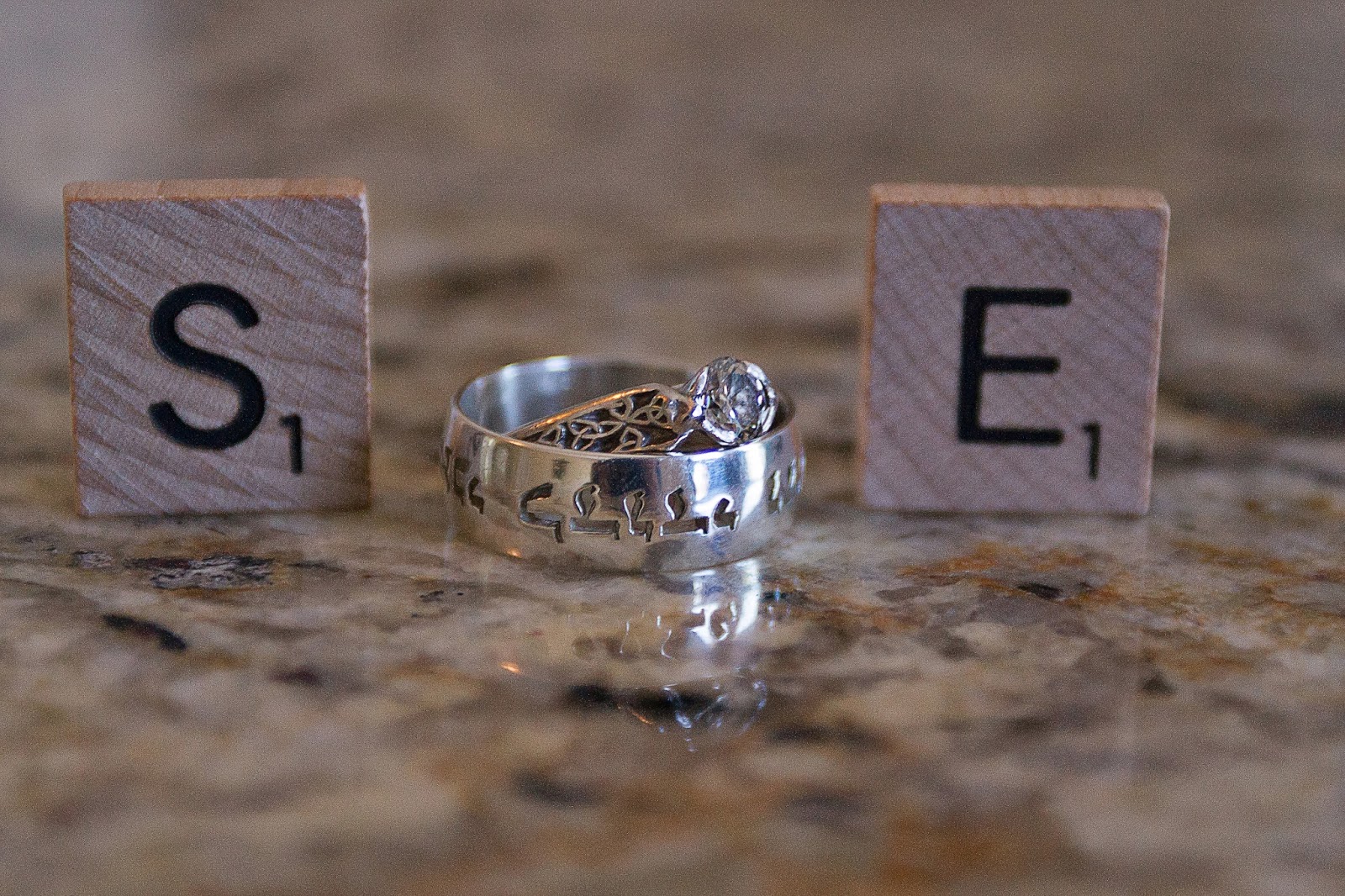
While in Ireland, I was looking for a souvenir for myself, and another girl on the trip pointed me in the direction of claddagh rings. Claddagh rings typically look like this:


They are used as Irish engagement rings and represent love (the heart), loyalty (the crown), and friendship (the hands). A claddagh ring is traditionally worn on the right hand's ring finger, and when a person is single, the heart of the ring faces outward toward the world, letting all eligible men and women know that the person is available. When a man or woman is in a relationship, the ring is turned around so that the heart face inward towards the wrist. And when a person has found the one that they want to spend the rest of their lives with, the ring is worn on the left hand's ring finger (just like an engagement ring).

I was never much for purity rings (there is nothing wrong with them, they just weren't for me). But something about this appealed to me; it was so incredibly romantic! So, I decided I would look for one for myself as well.

But I came across something even better. This:


That is a claddagh ring with the trinity on either side of the heart rather than the hands. I sat and pondered this ring, spinning it between my fingers over and over again and contemplating it. It meant something so much more to me. I reflected on something a pastor had told me when I was sixteen-years-old: "You and your future husband should collide in God's very presence." It was like, if the heart represented my romantic life (which had been, for lack of a better word, bumpy up until this point in my life), it needed to be taken out of my own hands and put in the middle of something else. There the heart was, safely protected under loyalty, and nestled in the presence of God, the inventor of romance itself.

I had to have it. And there it rested on my finger until the day it was replaced with my engagement ring (though there is a funny story about the time I lost it and had to replace it).

I told the ring's story absolutely everywhere I went. It was a daily physical reminder of how much God loves me, how much he was in love with me, and that he was taking care of me. For perhaps the first time in my life, I was completely satisfied in God with this part of my life. I finally understood the importance of surrendering these desires over to him. If I couldn't sustain my romantic relationship with God, how could I ever sustain it with another person? And by that I mean, if I couldn't remember how much God loved me, and held me together, and guided me, and provided for me, how could I see those things in a person? What an amazing time in my life. I had never felt so enveloped in love in my whole life.

The claddagh made for some pretty adorable moments in my relationship with my husband. I'll never forget the day he asked me to be his girlfriend (our second date, on the side of Stone Mountain, on one of the hottest days I can remember). Later that evening, while sitting on the same side of a booth in a place in Atlanta, my right hand in his, he asked, "don't we need to turn this around?" So he slipped it off my finger, turned it, and replaced it. What a stud. I am smiling like a giddy teenager even as I type this.

So, when it came time to find my engagement ring, my husband had mine made in Dublin, Ireland.

He had the trinity knots put on the band. When I first laid eyes on it, I couldn't believe how completely perfect it was!


So, the lesson here is simple: single or not, God is your first love. He is always going to be the Romancer of your soul. We have to be completely satisfied in him before we can be satisfied with another. I know that we say all the time we want a Christ-centered relationship, but I wanted a Christ-engulfed relationship. I wanted to, as the pastor told me, collide in the very presence of God.


Sunday, November 17, 2013

On Finding a Man (This Post Is Not Just For Women!)

It's the talk of the town: how does a single Christian woman find her husband?

Well, I am going to tell you how I found mine in hopes that, like me, you learn a lot from the experiences of others.

Here's the thing: I was single once. I get it. I understand you. You think that I cannot possibly relate to what you're going through. But you're wrong. Because I have been there.

A lot of you know my story; you know that I spent my singleness in preparation for my husband-to-be. But I want to share with you exactly what I mean by that. What I mean by that is not that I spent a lot of time learning the yummiest recipes, buying the cutest outfits, and memorizing Proverbs 31.

What I mean by that is, in all the times I had been single, I had always spent that time searching for my husband. But, in the bout of singleness I experienced before meeting Scooter, I tried something different. I tried not searching for him. I tried praying for him. I tried waiting instead of hunting.

This is difficult for those of us who color ourselves "impatient." There is something you need to ask yourself if you've ever described yourself in this way, especially in regards to your romantic life: What does your impatience over your future marriage say about your relationship with God? If, as a child, I ask my mother repeatedly, "when will dinner be ready? Is it ready yet? What are we eating? When are we eating?" what does that communicate? Is that the communication of someone who trusts that food will, in fact, be presented to them in the proper time? Or is that the communication of someone who fears that if they do not incessantly remind the preparer of the food of their hunger, that the preparer will forget about it?

I know what the single culture is like: It's competitive, cutthroat, ruthless, and a downright game. But I did not want to play the game. It makes you hungry. And that hunger can make you a monster. If you've ever skipped lunch or missed your morning coffee, you know exactly what I am talking about. That kind of hunger can control you and turn you into someone you don't even recognize.

Even in the church world, we can bat our eyes with the best of them. We find biblical loopholes that allow us to act like, for lack of a better term, complete idiots around the opposite sex. Shameless flirting within the church walls is still shameless flirting. I hated this about the single culture because it is so divisive. I valued my same gender friendships and guarded them carefully, but the incessant flirting and competition can make the environment toxic and hostile very quickly. Church, we need to intentionally watch out for this. Don't be that girl who messes with the boundary lines constantly. Please recognize your actions for what they are: acts of insecurity.

Flaunting your stuff is not a show of confidence; you are showing off how very little you think of yourself. And not just of yourself, but of your future husband.

Back to my story: I prayed for my husband. But I prayed for myself, too. A LOT. I asked myself, "What is God trying to do with me in this season?" I realized that I needed to take advantage of the time that I had a single person to figure out my own relationship with God, because maybe he was holding me back from that next season of my life for a reason. So, I prayed. And prayed. And prayed. I purposefully counted myself out of the single game, and owned up to being holy and separate and unlike the culture around me. And then, a question arose:

Emily, think about the person that you are searching for. Now, think about the kind of person that that person is searching for.

Are you the person that the person that you're looking for is looking for?

I needed to think about this some more. And, here's where I landed:

I studied some ancient beliefs about spouses. My favorite was the Hebrew belief that marriages were made in Heaven. Two souls are separated on earth and destined to find each other: soul mates. How incredibly romantic! That idea reminded me of a song from one of my favorite childhood movies:

I know you, I walked with you once upon a dream
I know you, the gleam in your eyes is so familiar a gleam
And I know it's true, that visions are seldom all they seem
But if I know you, I know what you'll do
You'll love me at once
The way you did once
Upon a dream


Sleeping Beauty

And, the most romantic idea occurred to me: I already knew my future husband. I started to recognize and identify my soul as something that was not of this world, something that had connections with the eternal and the Heavenly. My soul was destined to unite with another soul, who was also trapped in human form somewhere in the world. Even though I wouldn't recognize his earthly form, when we collided on earth, each pursuing our own individual godly purposes, our souls would recognize each other.

Stay with me! I promise it is not my intent to over-spiritualize this. But, the thing is, that's what we are. We are skin and bone, but what matters are our souls and our spirits. Right?

God gave us these magnificent souls, wrapped them in human form, and set our lives in motion. The Creator of all things, who fashioned and formed me very specifically and particularly, who knows absolutely everything about me, had already promised me a husband and soul mate. I realized that before when I was husband hunting, I was not trusting that God was going to provide something that he had already promised me. My husband was already mine. I did not need to win him or claim him; he was already promised to me, and I to him. I was truly my husband's betrothed. And I acted like it--like a woman who was spoken for.

Since the moment that Scooter asked me on our very first date, I have known that I am the only one in his life. I have known that I am the apple of his eye and the object of his affections. My confidence in these things never faltered. Do you think for one second that a relationship that spurs from the winning of a competition of short skirts and flirty laughs can boast the same confidence? Doubtful.

But, the key to this paradigm was that in order to obtain this sort of relationship, I had to be recognizable to my future husband. Because he would not recognize me as his based on my outward appearance, but by my heart, I had some close examination to do. I believed that our souls were destined for each other by God. So, it seemed logical to me that this meant that I should be as close to God's heart as possible. What I realized very quickly was that I was nowhere near as close to God's heart as I could be.

What I am trying to say is that finding your future husband is not about growing into the best Single Woman. It's about growing into the best Christian that you can be. It's about getting as close to God's heart as you can. Finding my future husband was not going to be like a blind date; my descriptors were not going to be, "I'll be the one in the little black dress with a Bible in my hand." I already knew who the man that I was looking for would be looking for: "I'll be the one making disciples, serving my church, seeking out God's will for my life, studying His word, singing His songs, etc."

That's the kind of woman that man you're looking for is looking for. Not the one who laughs the most flirtatiously. Not the one who flips her hair just right. Not the one incessantly asking God to fill her hunger for a husband. But the one who incessantly asks God to fill her hunger for Himself, and His word, and His purpose.

So, that is exactly what I did. I pursued and pursued and pursued God. And He did not let me down. He romanced me in ways that I never knew I could be. He set a mighty high bar for Scooter. I was so incredibly romanced by my Creator, that I had actually stopped looking around for my husband. In this way, God showed me exactly how to recognize my soul mate. And, you know what? I did. This was not a love-at-first-sight kind of thing. But, it was pretty fast. When I got to know Scooter's heart, I knew. I recognized him. I cannot in earthly words describe to you what sort of feelings came over me when I recognized him.

Every girl deserves this feeling. But first, you've got some work to do. You are first and foremost a Christian, so act like it. Do not let your hunger for a husband make you unrecognizable to your own soul mate. Let the God who created you romance you to the ends of the earth. Let God show you how to recognize your future husband. Trust God to fill your appetite with something so much better than you could have dreamed of. There is no shame or disappointment in this.

Wednesday, January 18, 2012

On Conservative and Charismatic Worship

As most of you know, I am one of the leaders for Southpoint Community Church's college group, Resolution. 

One of the reasons I love Resolution (and Southpoint) is because I feel comfortable to worship the way that I want. I feel at home in the midst of a worship session, and that's what's important to me in a worship session, and Resolution makes that happen.

(Thanks, Res!)

I have been doing a lot of thinking about worship lately, and about how many organizations have very conservative worships settings (or, in some cases, no worship [as in with music] at all). 

Let me begin by saying that I see nothing wrong with conservative worship styles; some people are just more conservative or shy than others. I do mind being made to feel badly about the way that I and my friends choose to praise Jesus. I hear a lot (and, I mean, a lot) of "Oh, yeah those crazy people who sing and lift their hands and jump up and down, they are so weird." Why? Why am I weird?

I would implore you to ask these questions: 

How do you act at a concert?

What do you do at a dance party or formal?

How do you react when you reunite with a friend that you haven't seen in a long time?

Do you sing along to the radio in the car (if you're anything like my sister and me, this singing is usually accompanied by loudness and hand gestures.)?

If your answers to any of these questions were "singing loudly", "dancing", "shouting", "jumping" or any other gesture or action of enthusiasm, volume or emotion, then why are we the weird ones for doing these things for the only one worthy of all of our praise?

If you are willing to make that much of a fool out of yourself for a performing artist who has no idea who you are, or to songs about nothing, then why won't you give at least that much to the God who died for you?

David, one of the greatest Kings of Israel, man after God's own heart, said "I will celebrate before the Lord. I will become even more undignified than this" (2 Samuel 6:21b-22a). 

I don't know about you, but I am definitely striving to be more like David. I mean, man after God's own heart (Acts 13:22)? I'd love to be known as something of the like. 

Wednesday, September 7, 2011

On Soulmates

Do you believe in soulmates?

The topic seems to be trending among my peers, stemming from an ongoing conversation about predestination vs. free will. I find it interesting how many people have conflicting views concerning these topics--belief in predestination, but not soulmates, or belief in free will with soulmates. Maybe we're confused about what "soulmates" actually are. Maybe we're confused about what all of these words mean.

A soulmate, by definition, is "one with whom one shares strong affinity [a natural liking for or attraction to a person, thing, idea, etc.]"[dictionary.com].

Furthermore, I will say that I believe in free will in a predestined universe. "Destiny" is "something that is to happen... to a particular person." I think the problem a lot of people have with the word "predestination" is the implication that God is forcing us to do something that, perhaps, we have no desire to do; God has decided our fates for us. I believe that we have the ability to make choices for ourselves, but I also believe that God knows all of our steps before we take them. This doesn't make our decisions any less ours, God simply knows the decisions we're going to make beforehand.

Therefore, given that we choose a life according to God's standards and biblical law, where does the concept of soulmates come into the equation?

It's fair to say that the idea of soulmates has been overly-mystified over the centuries, but it's important to remember that the concept existed long before Jesus was born. Greek philosophers and writers were infatuated with the concept of "twin souls," separated upon entering physical bodies, and in a life-long search for one another on earth.

"Bashert" is the Yiddish word for "destiny," and is used in the context of a predetermined spouse in Jewish culture; "basherte" is used to denote the female and "basherter" the male in a predestined marriage. One of the famous Jewish proverbs dictates that "marriages are made in heaven."

Actually, it doesn't sound so mystical anymore. It sounds biblical to me; it sounds superbly and exquisitely romantic.

There are billions of people on the planet, and surely many with whom one could find compatibility enough for marriage, but what of real, true soulmates? What about "twin souls"? Is this an overly-romanticized concept that makes for great movies and books, but doesn't carry any weight in real life? Or is this something real that too many people deny themselves in a world filled with liars, cheaters, and heart-breakers?

My past dating relationships were more than disappointing. They left me bitter, jaded, hurt, closed-off, walled-in; after a while, I was certain that if I watched one more relationship fail, I would simply move to Europe and forget about everyone else.

And then I dated again. And it failed again. And something amazing happened: I was alright.

Of course, I was hurt, and lonely, and a little angry. The truth of the matter is that, ultimately, I was content in then singleness that was obviously meant to be at the time. I began doing a lot of self-searching, and I realized that, despite my contentedness, my ideas about my future husband were rapidly changing, and I almost didn't realize it.

Some of the people around me--very well-meaning people, mind you--in an attempt, I'm sure, to be encouraging and motivating, were telling me, in more eloquent words that I can force myself to conjure, that I needed to lower my expectations for my future husband; that the man I had in mind simply did not exist.

I tried to find a balance between thinking realistically and not forgetting that God wants to give us the desires of our hearts (Psalm 37:4), but these seemed like conflicting ideas. God is not a God of delusion and disappointment, after all. I began to make it my prayer that my desires for my own life and God's desires would align, that whoever I was going to end up with would be exactly who God designed for me.

"Designed." The word came up again and again. This is what led to the "soulmate" conversation. This is when I began researching where the idea came from, and this is what I decided I believe:

I think, first of all, that God is the ultimate Romancer of our souls. He is love, and every page of the Bible is testament to this fact. His relationship with His people is the greatest love story ever told, and to expect anything less than a man whose desire is to love his wife the way that God loves us is to do a disservice to oneself and to God's handiwork (i.e., relationships in general; He is, after all, the Inventor of love and relationships.).

I think my idea of what a soulmate is is akin to the Greek idea of "twin souls." In my mind, a relationship is like a living organism designed by God Himself and composed of two major parts; two souls. I think that relationships are only successful when you enter into them with that only other person who can perfectly and seamlessly compose the other half of the relationship, and when you let God, the Designer of that relationship, do what He will with it.

So, don't fret, darlings! I'm tired of girls being deceived into thinking that just because there are a few jerks in the universe they need to lower their expectations for their romantic lives. Don't do it! God didn't offer His Son to save our souls so that we could live disappointing, sub-par lives. 

Sunday, June 19, 2011

On The Holy Spirit

Do not quench (suppress or subdue) the [Holy] Spirit;
1 Thessalonians 5:19 (AMP)

My Pentecostal background is about to show itself; Consider yourself warned.

I have been thinking a lot about the exact meaning of this verse; I have taken to writing it down on post-its and putting them in my direct view every day, reminding myself of the words and diction, tossing and turning them in my mind to fully understand their meaning and relevance to my life.

The diction of the verse is very important, though some of the pertinence is lost in translation. I believe those behind the Amplified translation of the Bible know this, and that is why they made it--to relieve the Bible of at least some of its ambiguities and "gray areas," to suppress argument, strife, and perhaps even some stress behind understanding God's intentions behind every verse.

"Do not quench (suppress or subdue) the [Holy] Spirit." This is exceedingly direct for a God who loves to speak in metaphors and parables. Therefore, there is a significance to this directness; There was to be no misunderstanding the instruction in this case; no personalization of this rule, and it is the same for everyone: Do not quench the Spirit.

"Do not..."
Don't do it! It's quite simple, really. There's no argument here.

"...quench..."
Suppress or subdue. Also easy to understand. So far, "Do not quench..." or "Do not subdue or suppress..." Got it.

"...the Spirit."
Whoa. Now I can see where people may become overwhelmed. 

Who is the Holy Spirit?

Before I can process this thought any further, I feel it necessary to define who I believe the Holy Spirit to be, and what that means in my life.

I feel that most of us (myself and people who read this) have a basic knowledge of the Trinity. If not, I'd love to blog about it later. Essentially, three in one. While I am aware that they are all God, I see them as different expressions of the same God (while I'm here, feel free to tell me when I make zero sense). God is the all-powerful, all-seeing, all-knowing, Creator of the universe; Jesus is God in the flesh; the Holy Spirit is our helpmate and guide through our lives. He is the part of God that plays an active role in everything that we do every day. The Bible says "And I will ask the Father, and he will give you another Counselor to be with you forever-- the Spirit of truth. The world cannot accept him, because it neither sees him nor knows him. But you know him, for he lives with you and will be in you" (John 14:16-17). Romans 8:27 says "the Spirit intercedes for the saints in accordance with God's will." 

The Holy Spirit is a Counselor, and He intercedes on our behalf. He is that faithful companion, the shoulder to cry on, the one who actively works for the good in our lives. 

So, the Holy Spirit is a good guy, on our side, a help in times of despair--why is this verse so threatening? "Do not quench the Spirit." One reason for feeling overcome with confusion, I believe, is this: the implication is that it is possible for you to quench, suppress, or subdue the Holy Spirit. Personally, the fact that something that I can do can hinder the work of the Holy Spirit in my life or the lives of those around me does not sit well. I actually had a difficult time with this passage until recently. 

Without diving into specifics, I recently felt the affects of someone quenching the Holy Spirit in my own life. The worst part about this experience was that it was not the person's intention. Actually, the intention was to help me (and others) to engage in worship and prayer. Unfortunately, the exact opposite effect was the direct consequence of these exhortations. I wasn't completely aware that it was happening, I just knew that I was trying harder than is usually necessary to have a desperately-needed moment with God, and something was getting in the way of that. What made this worse was that I felt powerless against it; It wasn't until I was alone at home with my Bible that I was finally able to concentrate and get what I felt I needed from God that night.
 
I think, at least in this case, this hindering has a lot to do with trusting (or not trusting) the Holy Spirit to do its job. It's an elementary example of not "letting go and letting God." It's also a testament to the devastating consequences that not trusting God can have in our lives and the lives of others. We can affect how God works in life. This is an obvious example, but what about the non-obvious cases?

How many times has my desire to have control over my own life actually hurt me? If I retrace my own steps, I can see where the Holy Spirit was prompting me to do one thing, and I did another because it made more sense to me at the time. Where did I end up as a result of these actions? Hurt, alone, confused, abandoned, rejected, jaded, broken, blinded, scarred, terrified, mortified, embarrassed, humiliated--these are not the purposes for which God designed me.

This is where the fruit comes in.

When we let the Holy Spirit control our lives instead of taking our own misguided and selfish advice, what is the end result?

But the fruit of the [Holy] Spirit [the work which His presence within accomplishes] is love, joy (gladness), peace, patience (an even temper, forbearance), kindness, goodness (benevolence), faithfulness, gentleness (meekness, humility), self-control (self-restraint, continence). Against such things there is no law [that can bring a charge].
Galatians 5:22-23 (AMP)

Now it all makes sense. It can be tempting to quench the Holy Spirit (even without knowing it), because the thought of letting someone or something else control your life is scary; Not having absolute control is intimidating and terrifying. However, how has doing it your way worked for you so far? Do I need to repeat my list of consequences of having control over my own life? I fear too many would have a similar list. When I let the Holy Spirit guide and counsel me in my decisions...

...I am loving: I have a love I can't explain for the people in my life. Those people can feel how much I love them, and I can feel their love for me as well. I have a love that cannot be quenched or doused in any way. 

...I am joyful: I am filled with a happiness that does not depend on the actions of people (not my family, nor my friends, nor any others), who have failed me time and time again, and left me stripped of joy and gladness. I am reminded constantly of God's enduring and faithful love for me, and it fills me with a happiness that must be expressed at every possible moment. 

...I am at peace: Peace is something that eluded me for many years. In fact, I'm not sure I knew what peace was during the entire duration of my adolescence. Only in the last year or so of my life have I had moments where I know, beyond the shadow of a doubt, what it is to be at peace, to know that God has not forgotten or abandoned me, to know that He saw every tear I shed over every person who ever hurt me, and to know that He had the plan that was going to relieve that kind of pain. All I had to do was accept His plan and His will, even if I didn't know exactly what the plan entailed. He hasn't failed me yet.

...I am patient: I have found that when you pray for God to grant you patience, He doesn't so much instill automatic patience within you, but gives you opportunities to be patient. Sometimes I am successful, other times, not-so-much. But when it really counts, I can feel the Holy Spirit tugging on my heart, and telling me to hold on, to wait, to listen, to take a breath--that He's got it, and I simply need to be patient to discover what His plans are.
...I am kind: We don't see a lot of kindness in today's world. We see "niceness," but not genuine, selfless kindness. The Holy Spirit is the only thing that could possibly give me the capacity to exhibit such a rare trait.

...I am good: There is a reason why Paul mentions "kindness" and "goodness." While kindness implies an inexplicable friendliness, goodness connotes selfless charitableness. Anyone who has been paying any sort of attention to the world around them is aware that such behavior does not exist in human nature. That is why it is a fruit of the Spirit.

...I am faithful: Unfortunately, this doesn't exist in human nature either, and some of us are reminded of it every day. Divorce is an obvious example; I myself have struggled with the fidelity of not only friends, but a boyfriend as well. Our generation, for one reason or another, has a weak spot for unfaithfulness. When the Holy Spirit is living and active in our lives and the lives of those with whom we choose to be in intimate relationship, these fears of infidelity or non-trustworthiness can dissipate so that true relationship can form, and so we can experience more of God in those faithful relationships.

...I am gentle: The Holy Spirit not only gives you peace, but gives you the ability to pacify others (a characteristic of gentleness). I believe gentleness is also exemplified in the softening of our hearts when we let the Holy Spirit do its work. I have had a lot of people tell me that after what I've experienced, they see no reason for me to have any grace with friends or romantic relationships, but my heart, while it has learned quite a few lessons, is relentless. What could explain this? Not determination in people on my part. Faith in what the Holy Spirit can do is what keeps us moving when the world expects us to stop; it's what keeps us soft and warm when the world tries to make us hard and cold.

...I have self-control: I have boundaries, and the ability to say "yes" and "no." I make the right decisions--not the easy decisions, but the right ones. I know when to hold my tongue, and how to control my actions and behaviors. It is never easy, but I am certainly better off for it.

None of the above qualities are inherent in human nature. That is why we need to Holy Spirit. I would encourage you, Church, to examine yourself and ask if the Holy Spirit is truly in control of your life, not just for your benefit, but for the benefit of those you love.